Mexico’s industrial real estate market is experiencing a period of growth. Industrial buildings have become some of the most in-demand assets, driven by the nearshoring phenomenon and the arrival of foreign direct investment—totaling $12.2 billion USD by the end of the first quarter of the year.
In this context, it is crucial for investors, landlords, and companies to understand the classification of industrial buildings by use in Mexico, as it defines their positioning within a constantly evolving market.
How are industrial properties classified?
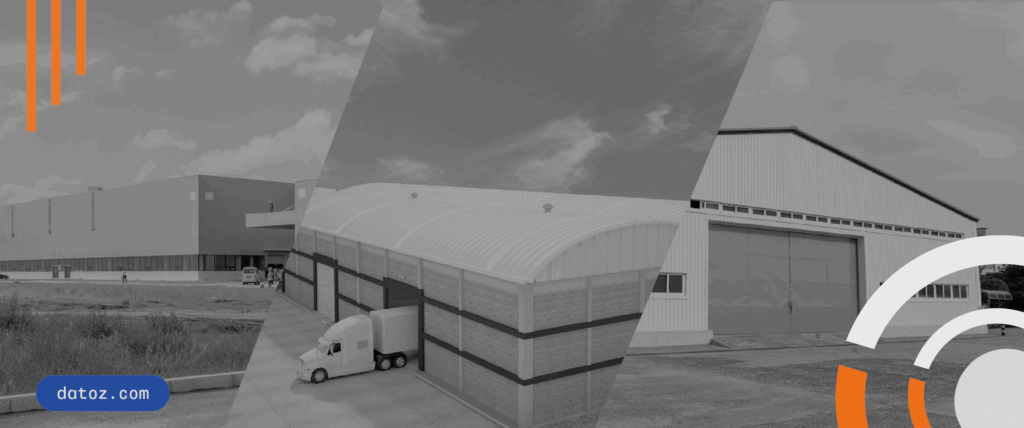
Mexico’s industrial market is vast and adapts to the needs of multiple industries—from logistics to manufacturing. To better understand it, industrial properties are generally classified as follows:
Logistics buildings
These spaces are designed for the distribution and storage of goods. They are typically located near airports, ports, and major highways to ensure smooth connections across national and international supply chains.
- Clear heights between 9 and 12 meters.
- Loading and unloading systems for efficient operations.
Last Mile-buildings
- Located in large urban areas, forming part of the final stage in the supply chain.
- Primarily used by the logistics and transportation sectors.
- Designed for B2C operations, focusing on fast product delivery to end consumers. Examples include Amazon, Mercado Libre, and DHL.
Light manufacturing buildings
Focused on assembly and production processes with moderate technical requirements.
- Commonly used by the electronics and automotive sectors.
- Require office areas within the warehouse.
- Predominantly found in the Bajío and northern regions of Mexico.
Heavy manufacturing buildings
Designed for industries with intensive processes and heavy machinery.
- High-resistance flooring.
- Large land areas.
- Specialized services such as high-voltage power supply.
Distribution centers (CEDIS)
Infrastructure focused on inventory management and rapid delivery.
- Characterized by large storage areas.
- Equipped with advanced logistics and automation technology. Commonly used by retail and supermarket chains.
Industrial Parks
Planned developments consisting of multiple industrial buildings that share common infrastructure and additional services, such as:
- Security, internal roadways, water and energy supply.
- Strategic locations within major industrial regions in the North and Bajío, such as Nuevo León and Tijuana.
Industrial parks also have their own classifications based on:
-Infrastructure development stage: Under construction, Stage 0, Stage 1, Stage 2, Stage 3, and Operational.
-Primary purpose: Manufacturing, logistics, mixed-use, or dedicated.
-Layout: Open or closed perimeter.
-Size: Type I, II, or III.
Why is this classification important?
These characteristics help determine the quality, sustainability, and location standards of industrial properties—factors that directly impact their appreciation and profitability.
For example, a building with international certifications can attract long-term lease agreements, while an outdated property or one lacking proper infrastructure may face high maintenance costs or low demand.
To learn more about the features of industrial properties in Mexico, request a demo from Datoz.